










A website answers “who are you?”.
A sales funnel answers “what do I do now?”.
The whole difference between informing and selling lies in those two questions.
I built funnels for years.
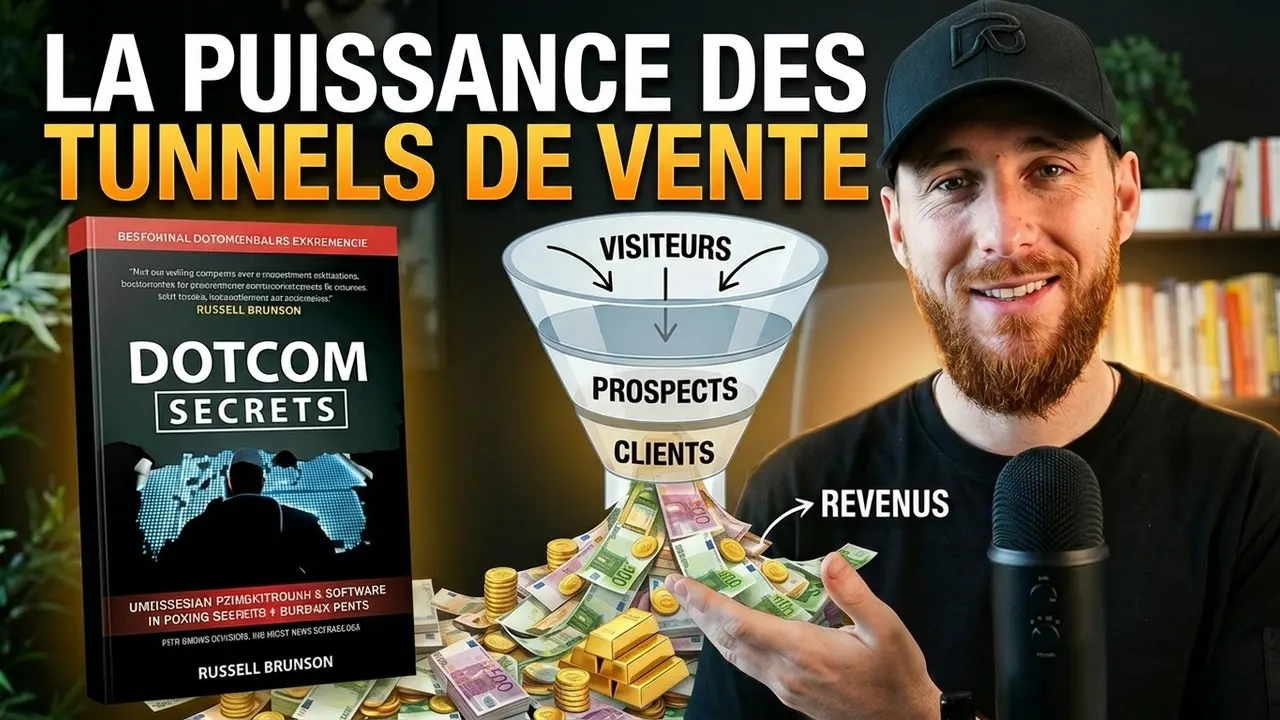
Enough to receive ClickFunnels' Two Comma Club: the trophy awarded when a single funnel passes a million in revenue.
Here's the method I wish I'd read at the start.
The video gives you the big picture in 12 minutes.
The article, the step-by-step.
What is a sales funnel?
▶ 01:57 in the videoA sales funnel is a series of pages that guides a visitor, step by step, from discovery to purchase, and beyond.
On a website, the visitor clicks everywhere.
In a funnel, each page has only one possible action: move forward, or not.
That constraint is what drives sales up.
It's also called a conversion funnel.
At each level, people drop off.
The ones who stay get warmer and warmer.
- AAttentionTrafficAds, Google, social media, emails
- IInterestContact captureOpt-in page and free gift
- DDesireSales pagePromise, proof, offer
- AActionPurchase and add-on offersOrder form, order bump, upsell
The whole art is getting as many people as possible down from one level to the next.
Why a funnel sells more than a website
▶ 03:58 in the videoA good salesperson doesn't recite the catalog.
They listen, offer one thing, handle the objection, offer the next.
A funnel is that salesperson, 24/7.
On a website, your visitor has a thousand exits.
The menu, the blog, the legal notice.
Close them one by one.
5 open exits
One page, one decision.
The visitor can't “go look elsewhere” anymore.
They move forward, or they stop.
Second reason: escalating commitment.
Every small yes (leaving an email, watching a video, checking a box) makes the next one easier.
Third reason, the most important: the value per client skyrockets.
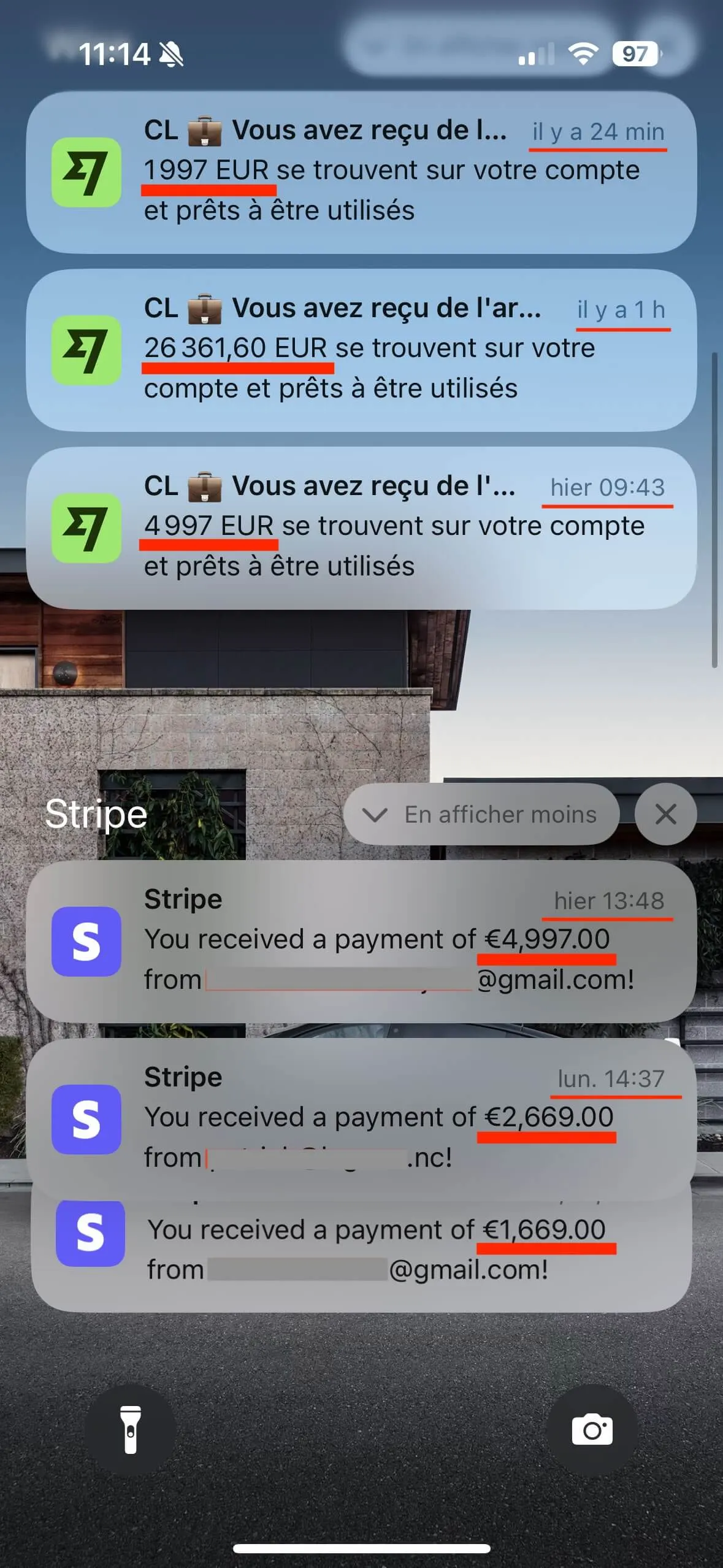
With add-on offers, a client no longer buys €27, but €27, then €47, then €197.
The funnel doesn't convert more by magic.
It stacks several chances to buy, and it wins back the undecided with follow-ups.
And that's the real secret.
Russell Brunson, the founder of ClickFunnels, sums it up in DotCom Secrets:
“Whoever can spend the most to acquire a customer wins.”
The more a client brings you, the more traffic you can buy while staying profitable.
The value ladder: strategy before pages
▶ 00:46 in the videoStrategy before technique.
The backbone of a good funnel is the value ladder, Brunson's “Value Ladder”.
You never pitch your most expensive offer to a stranger.
You walk them up rung by rung.
And each rung pays for the next one.
- Rung 1 · The bait0 à 7 €
A free gift or a very small product.
The stranger becomes a contact, then a first buyer. - Rung 2 · The core offer27 à 297 €
Your main product.
The one the funnel really sells. - Rung 3 · Premium€500 to €2,000 and up
Coaching, mentoring, “done for you”.
For those who climbed the rungs before. - Rung 4 · Recurringevery month
Subscription, community, mastermind.
The income that stabilizes everything else.
Once the ladder is clear, the funnel is just a way to walk people up it.
All the mechanics are in my DotCom Secrets summary.
A funnel without a ladder
is a funnel
that leads nowhere.
Now, the build.
Seven steps, in order: each step sets up the next.
Step 1. Define your offer and your ladder
How do you build a sales funnel that sells?
First, without any tool.
What are you selling, and to whom?
A funnel won't save a fuzzy offer.
Be surgical about the result you promise and the exact person you promise it to.
Then place it on the ladder: where the stranger comes in, and what they climb toward.
Step 2. Pick the right type of funnel
There isn't one funnel, there are families.
It all depends on how much trust you need to earn before the purchase.
The higher your price, the more you need to warm up your prospect.
You sell afterwards.
Perfect for building a list.
The curious visitor becomes a buyer.
Then you chain the add-on offers.
The “VSL”.
Ideal from €100 to €2,000.
Deadly effective for premium offers and courses.
Pick just one to start.
You don't build four funnels at once.
You build one that sells, then you improve it.
Step 3. The opt-in page: an email, nothing else
▶ 04:20 in the videoThe opt-in page has one job: get the email, in exchange for your free gift (the “lead magnet”).
Its golden rule: strip it down.
A strong promise in the headline.
One sentence on what the person will get.
A form, a button.Menu, links, aboutnothing else.
A good opt-in page signs up 25 to 50% of targeted traffic.
Below that?
Your promise isn't specific enough, or your free gift doesn't solve a burning enough problem.
Step 4. The sales page: 80% of the result
▶ 05:32 in the videoIt's the heart of the engine.
It lays out the pitch, in this order:
- The promise.
Clear, in one sentence. - The problem.
You stir it up, in the client's own words. - Your unique mechanism.
Why your solution is different. - The proof.
Results, testimonials, screenshots. - The detailed offer.
Everything the person gets. - Objections handled.
Before they block the purchase. - The guarantee.
It reverses the risk. - A crystal-clear call to action.
Just one.
“The moment of pulling out the credit card is a hard moment for people, because it's an act of trust.”
Never rush this page.
Decent design with excellent copy will always beat gorgeous design with hollow copy.
Write first, decorate later.
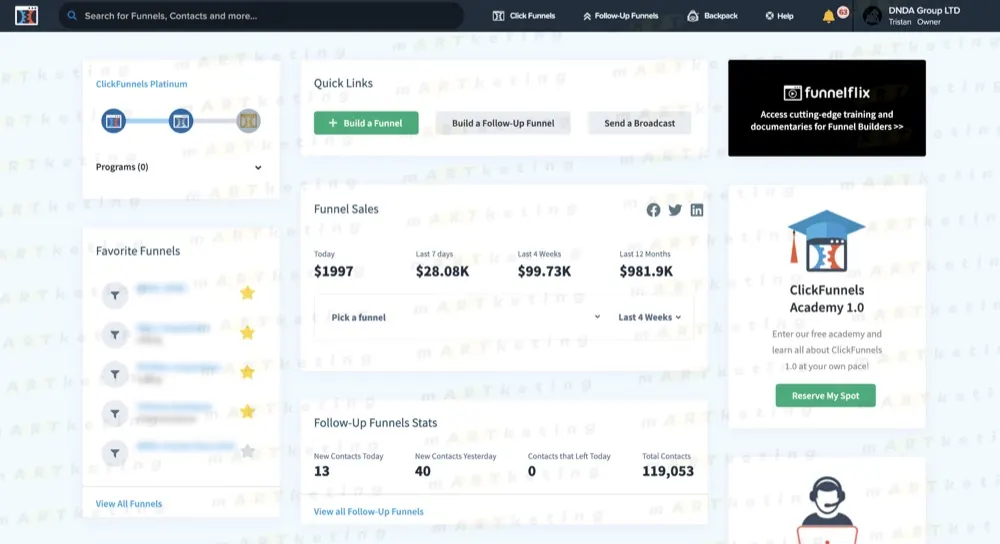
That's thinking in funnels rather than websites.
I come from design, and I admit it in the video: most funnels are pretty ugly.
They still sell more than beautiful websites: every element pushes toward the next step.
Step 5. The order form and its order bump
The order form is your checkout page.
Keep it simple: the offer summary, the card fields, a reassuring button.
Every extra field drags sales down.
Then add an order bump: a small checkbox, right above the payment button.
It offers a low-priced add-on.
“Add the template pack for €19.”
The client already has their card in hand.
20 to 40% say yes.
It's the most profitable addition to your funnel, for the least effort.
Step 6. One-click upsells
▶ 06:45 in the videoRight after payment, before the thank-you page, offer a “one-click” upsell.
A higher offer, accepted in a single click, without re-entering the card.
“You just got the course.
Want the group coaching at 50% off, only right now?”
Those who say no see a lighter, cheaper version: the “downsell”.
- Entry product€17
- + Order bump+ €8
- + One-click upsell+ €36
Total€17
These numbers are an example, not a client result.
Same €17 entry product.
The average order goes to €25, then €61.
Without touching your ads, each client brings in 3.5 times more.
That's exactly the lever that gets a single funnel to a million.
Step 7. Email follow-up
▶ 08:06 in the videoMost people don't buy on their first visit.
Without follow-up, you leave most of your money on the table.
Two automations are non-negotiable:
- The sequence for subscribers who didn't buy.
Emails that bring value, handle objections and lead back to the offer. - Abandoned cart follow-up.
For people who started paying but didn't finish.
A simple reminder often recovers 10 to 15%.
Your funnel knows where each prospect stopped: each email speaks to where they are.
The follow-ups I really use are in how to automate your business with AI.
All seven pieces are in place.
Now let's watch them run together.
Example: a sales funnel from A to Z
Take a coach selling a €297 course.
Here's her funnel, end to end (illustrative example).
- 38 %
Her ad leads to an opt-in page offering a free guide: “The 5 mistakes killing your sales”.
38% of visitors leave their email. - 6 %
Right after, a €17 mini-course.
6% buy, which already pays back part of the ads. - 30 %
On the order form, a €27 order bump: a template pack.
30% check it. - 12 %
As a one-click upsell, the full €297 course.
12% of buyers say yes. - 4 %
Those who didn't buy get 5 emails over a week.
They bring in 4% more sales.
A sales page alone would barely convert at 1%.
Hers stacks the chances to buy.
The order value climbs, the ads become profitable again.
Stacking wins, not the miracle page.
Which tool should you use to build your sales funnel?
The tool doesn't make the strategy.
Here are the three I've really used.
ClickFunnels
The most polished for funnels and upsells.
Huge ecosystem and training.
The downside pricier.
systeme.io
French, simple, very cheap, with a free plan.
Ideal for a first funnel.
The downside less advanced.
GoHighLevel
Funnel, client list, emails, texts, calendar and automations in a single tool.
My pick the best balance of power and all-in-one.
My pick today is GoHighLevel.
A standalone funnel isn't enough anymore: I want capture, follow-up, booking and client tracking to live in the same place.
 1h49 of live building Watch me build a complete funnel in GoHighLevel The GoHighLevel guide, setting by setting →
Selling digital products?
Check out the complete system for digital products.
The 5 numbers to track
Watch these five numbers, page by page.
When a rate drops, you know which page to fix.
Push it up.
Above what a visitor costs you.
The rule: one variable at a time.
And always the weakest step first.
That's where you recover the most sales for the least effort.
The 5 mistakes that kill a sales funnel
- Selling everything on one page.
One decision per page.
Stack the steps, don't cram them. - Neglecting the copy.
People polish the design and push the copy to later.
It's the other way around: copy comes first, it carries 80% of the result. - Zero follow-up.
No emails means most of your sales thrown away. - Cold traffic to an expensive offer.
Without a ladder, you're proposing marriage on the first date. - Measuring nothing.
Without your rates page by page, you can't improve anything.
How long does it take, how much does it cost?
A simple funnel (opt-in, sales page, emails) takes a day to build with a modern tool.
A complete funnel (sales video, order bump, upsells, automations) takes one to two weeks.
On the software side: from free on systeme.io to about €27 to €97 a month for a serious tool.
The real cost is the time it takes to write an offer that holds up and copy that sells.
Many people prefer to have it built once, properly.
Don't chase the perfect funnel on the first try.
A live funnel beats a perfect funnel that only exists in your head.
Your checklist to launch this week
Enough theory.
Here's the bare-minimum plan to get a first funnel live within seven days.
- Your offer in one sentence.
“I help [who] get [result] with [method].” - Your free gift and your funnel type.
To start: a free gift, then a sales page. - Your account.
systeme.io to get started, GoHighLevel to centralize everything. - The opt-in page.
A promise, a form, zero distractions. - The sales page.
The 8 blocks from step 4, in order. - An order bump and a one-click upsell.
- 5 emails and the abandoned cart follow-up.
- Traffic.
Then you read your rates and improve the weakest step.
Eight lines, one week, and a funnel that runs.
Frequently asked questions about building a sales funnel
What is a sales funnel?
A series of pages that guides a visitor, step by step, from discovery to purchase, then toward complementary offers.
It's also called a conversion funnel.
Unlike a website, each page has only one possible action.
That's what drives sales up.
How do you build a sales funnel for free?
Start with the free plan on systeme.io: opt-in page, sales page and emails, no coding.
What matters isn't the tool but the structure: a clear offer, a free gift, one page per action, an email follow-up.
A first funnel takes an afternoon to build.
What's the best tool to build a sales funnel?
ClickFunnels is the most powerful benchmark.
systeme.io is the most accessible French option to get started.
GoHighLevel brings funnel, client list, emails, texts, calendar and automations together in a single tool.
The right choice depends on your budget and how much you want everything in one place.
What's the difference between a sales funnel and a website?
A website informs and lets the visitor browse freely.
A funnel chains pages with only one possible action on each, in a precise order, all the way to the purchase.
A website answers “who are you?”.
A funnel answers “what do I do now?”.
How long does it take to build a sales funnel?
A simple funnel takes a day to build with a modern tool.
A complete funnel, with a sales video, order bump, upsells and automations, takes one to two weeks.
The longest part isn't the tech: it's writing the offer and the copy.
How much does a sales funnel cost?
On the software side: from free (systeme.io) to about €27 to €97 a month for a serious tool like ClickFunnels or GoHighLevel.
The real cost is the time it takes to write a solid offer and copy that sells.
Or the budget to have it built properly, once: that's the GoHighLevel Setup.
Take action
Building a sales funnel isn't magic.
It's structure.
And structure can be built in a week.
The best time to have started was a year ago.
The second best is now.