









Some books you read too late.
For two years, I built websites that sold nothing.
Pretty, well coded, with good copy.
But no system, no sales logic.
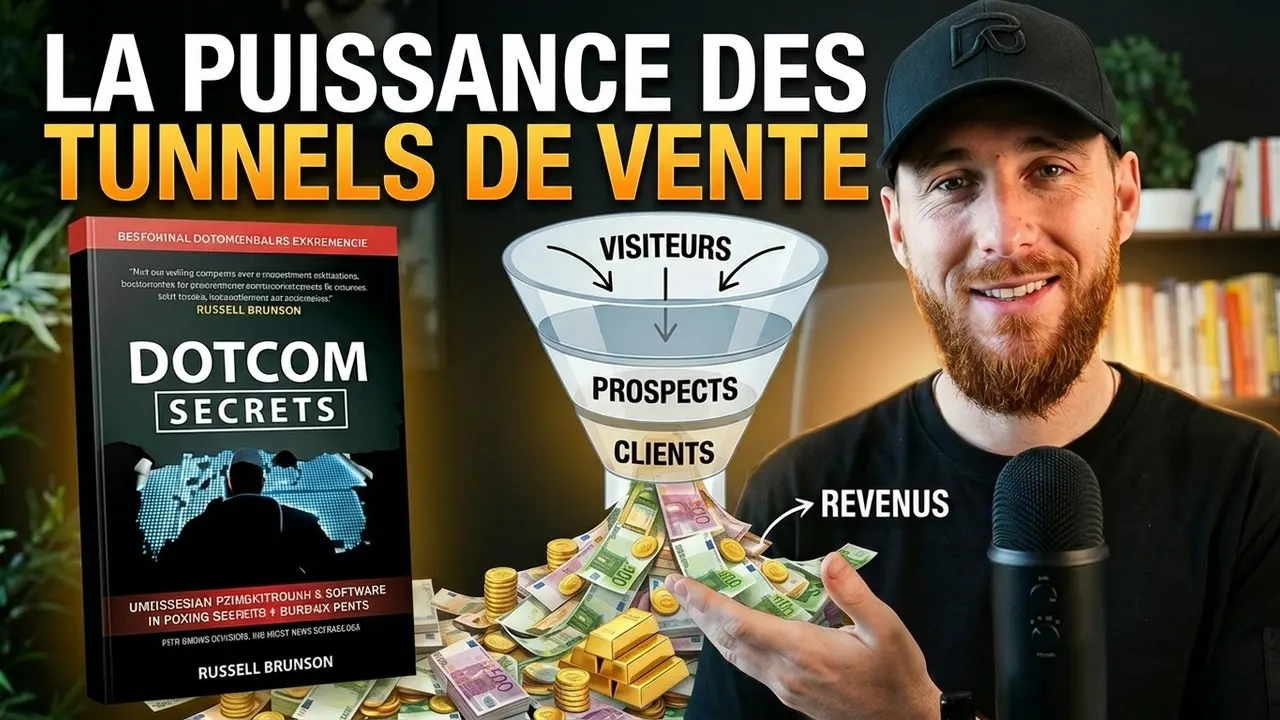
Then I read DotCom Secrets by Russell Brunson, the founder of ClickFunnels.
Not a magic book.
A book that names what you're doing halfway, and puts it back in an order that holds up.
Here's my DotCom Secrets summary: the 8 ideas I still use.
Plus 3 mockups so you can test them yourself.
"Whoever can spend the most to acquire a customer wins."
DotCom Secrets: the 60-second summary
DotCom Secrets explains how to sell online with a system instead of a product.
You define your dream customer, then you build a value ladder: a free offer, then offers that get more and more expensive.
A sales funnel moves each prospect up one step.
An email sequence and a likable character do the rest.
The book barely talks about tools.
It talks about the order of things.
Secret 1. The Secret Formula: the 4 questions everyone skips
▶ 00:00 in the videoAlmost every creator starts with the product.
I used to be one of them.
It's the exact opposite.Start with the product.Start with the customer.
"I see too many people focusing on the product or service they're selling instead of focusing on the sales system."
Brunson calls it the Secret Formula.
Four questions, in order, before you touch anything.
Asked honestly, most people can't answer them.
And as long as they stay fuzzy, everything else is built on sand.
Secret 2. The value ladder: why your ideal customer isn't buying (yet)
▶ 00:48 in the videoYour perfect customer listens to your most expensive offer.
And leaves without buying.
They don't know you well enough yet to trust you at that price.
Trust gets built one step at a time: that's the value ladder.
- Step 1 · Free€0Ebook, mini-course, free consultation.
Goal: capture an email. - Step 2 · Entry€7 to €97Turn a prospect into a buyer.
- Step 3 · Middle€300 to €1,000Course, group coaching.
- Step 4 · High€1,000 to €10,000One-on-one coaching, "done for you".
It pays for everything else.
The first paid step gets the card out of the wallet for the first time.
"A buyer is a buyer is a buyer," says Dan Kennedy: someone who paid €7 can climb higher.
And the top step pays for acquiring the ones below.
Bring people in
at the bottom of the ladder,
where there's
the least resistance.
One question left: who's going to climb your ladder?
Secret 3. The 3 types of traffic: only one truly belongs to you
A ladder with no traffic is a shop at the end of a back alley.
And not all traffic is equal.
Ads.
Predictable, scalable, but paid.
Only good use: send it to an email opt-in page.
Social media, SEO, shares.
It shows up when it wants.
The algorithm changes, and it can all vanish overnight.
Your email list.
Nobody can take it from you.
You talk to it whenever you want, for free.
The first two have only one purpose: filling the third.
It's the only lasting asset of an online business.
To fill it, you need a page.
Secret 4. Your most important page isn't your sales page
▶ 04:23 in the videoPeople polish their sales page for weeks.
And neglect the one that decides whether anything else will exist: the opt-in page.
It works under three conditions, all at once:
- A concrete result.
Your prospect knows exactly what they'll get. - Zero barrier.
No credit card, no commitment, just an email. - Instant delivery.
They get what you promised within seconds.
The classic mistake: saving the best for the paid stuff.
Brunson says the opposite.The leftovers for free.Your best for free.
An irresistible gift makes people want more.
Now, the money.
Secret 5. The funnel: how to make €300 from a €0 product
▶ 06:48 in the videoBrunson hammers home a counterintuitive principle: the real offer is never the first one.
It hides behind add-on offers ("upsells") and fallback offers ("downsells").
Put yourself in the prospect's shoes.
The free ebook
0 €
0 €
Example amounts, taken from the book's ranges (just below).
A prospect who came in at €0 can leave with nearly €300 in the same session.
The funnel pays for itself.
Every euro you spend on ads comes back, or almost, right away.
The book's ranges, offer by offer:
- The gift.
Free or symbolic: €0 to €7. - The entry offer, and its checkbox.
€7 to €47, plus €27 to €97 added on the order form (the "order bump"). - Upsell 1.
€47 to €197, right after payment. - The downsell.
A free 7-day trial, if they turn down the upsell. - Upsell 2.
€197 to €297.
Beyond that, I don't recommend it.
And don't reinvent the wheel.
A competitor has been running the same ad for six months?
Their funnel is profitable: study it, then adapt it.
To put it into practice: how to build a sales funnel, step by step.
To pick the tool: systeme.io vs GoHighLevel.
Secret 6. The SOAP sequence: if your first email is boring, you're done
▶ 08:07 in the videoMost people send a bland welcome email, then "educational" emails that run out of steam.
Brunson's verdict is brutal: if the first one is boring, the next ones will never get opened.
His answer: the "Soap Opera" sequence, like a TV show.
Each email opens a loop that the next one closes: the cliffhanger.
The ground rule: 90% entertainment, 10% content.
People don't subscribe to learn.
They subscribe because they like who you are.
Every email follows the trio "hook, story, offer".
And Brunson writes every day, in an automated email tool: otherwise, the bond fades.
Now, who's signing them?
Secret 7. The attractive character: nobody wants Superman without kryptonite
▶ 10:17 in the videoYour product doesn't sell.
You do.
The "Attractive Character": in my opinion, the most underrated concept in the book.
Polarity
If you try to please everyone, you interest no one.
Taking a stand pushes part of your audience away: that's the point.
The others would never have bought.
Vulnerability
Looking flawless doesn't make you credible.
Superman without kryptonite is a statue: admirable, but cold.
"He explains that even superheroes have weaknesses, and that's also why we love them so much."
Your flaws don't weaken you.They make you fragile.They make you real.
Story and parable
Your story needs a direct link to what you sell.
Otherwise, it's an anecdote with no purpose.
And the parable, a short story people repeat, spreads your message without you.
Now you need to test it without getting lost.
Secret 8. The 5 variables: never change more than 2 at a time
A funnel is five linked variables: the audience, the offer, the opt-in page, the traffic, and your ad's message.
Brunson's rule, which I learned the hard way: never more than two unknowns at a time.
You change the offer and the traffic at the same time, and results drop?
You'll never know which one broke it.
Results go up?
You won't know which one saved the day.
You're flying blind, and burning your budget on guesses.
The message follows the temperature of the traffic
Your prospect already knows your product: your headline starts with the product.
They know what they want, but not your solution: it starts with the desire.
They just feel a problem: it starts with the problem.
A mismatched message: the number one reason ad budgets get burned.The budget.The message.
Ugly funnels that sold anyway
▶ 07:23 in the videoI have a background in multimedia.
I designed websites for the French Football Federation and for the 24 Hours of Le Mans.
And my first funnels were so ugly I didn't dare show them to my friends.
Yet they're what I started selling with: they followed the ladder, not the looks.
"I have to admit, most sales funnels are often pretty ugly. But since they're built for conversion…"
Beauty doesn't sell, the mechanics do.
A well-configured customer database, emails that build a bond, a ladder that makes sense: that's what runs a million euros a year.
Not a perfect website.
Want to see the mechanics built from A to Z?
It's all in my GoHighLevel sales funnel guide.
DotCom Secrets FAQ
What is the book DotCom Secrets about?
DotCom Secrets, by Russell Brunson, explains how to sell online with a system instead of a product.
Inside: the Secret Formula, the value ladder, the three types of traffic, the opt-in page, upsells, the Soap Opera Sequence, the attractive character and the five variables of a funnel.
What is Russell Brunson's value ladder?
A series of offers that get more and more expensive.
A free offer that captures an email, an entry offer between €7 and €97, a middle tier between €300 and €1,000, a high tier between €1,000 and €10,000.
Each step builds trust for the next one.
What is the Soap Opera Sequence (SOAP)?
A series of emails built like a TV show.
Each email opens a loop that the next one closes: the stage, the drama, the backstory, the epiphany, the hidden benefits, the urgency.
The rule: 90% entertainment, 10% content.
Do you need ClickFunnels to apply DotCom Secrets?
No.
Russell Brunson founded ClickFunnels, but the book's principles don't depend on any tool.
Value ladder, opt-in page, upsells and email sequence can also be built in GoHighLevel or systeme.io.
To choose, read my comparison systeme.io vs GoHighLevel.
Where should you start after reading DotCom Secrets?
With the ladder, not the design.
Answer the four questions of the Secret Formula, then build your first step: an opt-in page with an irresistible gift, delivered right away by email.
Until you have an email list, you're building on traffic that belongs to someone else.
If you remember only one thing
Build the ladder first.
Everything else hooks onto it naturally.
No email list?
Then no business.
Just content that belongs to someone else.