












Up at 6 a.m.
In bed at midnight.
And without you, nothing runs.
You started your business to be free.
You're juggling everything, and you can't seem to delegate.
I know that feeling very well.
According to Michael Gerber, 80% of businesses fail in their first five years.
Not for lack of talent.
Because of a mistake so logical you don't see it coming: the E-Myth, the entrepreneurial myth.
Here's my summary of The E-Myth Revisited.
If you built your business out of your trade, this book is about you.
"People work in their business instead of working on their business."
The E-Myth Revisited: the 60-second summary
The E-Myth Revisited, by Michael Gerber, explains why small businesses fail.
Their founder believes that knowing how to do the work is enough to run a business that does that work.
The fix: build your business like a franchise.
A documented system that runs without you.
The book boils down to one shift: working inon your business.
And it all starts with an assumption.
Chapter 1. The fatal assumption: you didn't build a business, you invented yourself a job
▶ 05:30 in the videoThe story always starts the same way.
You're good at your trade: hairdresser, electrician, coach, developer.
You're sick of working for a boss.
What you do for him, you could do for yourself.

Knowing how to do the work doesn't mean knowing how to run the business.
Gerber calls it the fatal assumption: "if I understand the technical work of a business, I understand a business that does that work".
It's wrong.
Making a great hamburger has nothing to do with running a restaurant.
You didn't free yourself.
You found yourself a new place to work.
And in that new place, you're not alone.
There are three of you.
Chapter 2. Technician, manager, entrepreneur: you're three people at once
▶ 07:30 in the video
The one who does the work, and takes up all the room.
For Gerber, every founder carries three personalities.
They're constantly fighting for the wheel.
And looking at the same business, they see completely different things.
Sees work.
"If you want it done right, do it yourself."
Sees problems.
Tidies up the chaos.
Without him, nothing holds.
With him alone, nothing grows.
Sees opportunities.
Builds one house and is already sketching the next.
The problem: according to Gerber, most founders are 70% technician.
The entrepreneur has an idea, the manager tries to organize.
And the technician grabs the wheel to do everything himself.
As long as they don't get along, your business stays a battlefield.
Chapter 3. Infancy: your business becomes the boss you wanted to escape
▶ 01:30 in the videoPhase one: you do everything.
Sales, accounting, operations, delivery, customer service.
At first, it holds up: you've got energy and low volume.

You do everything, all the time, and eventually you burn out.
Then the business takes off.
You work later, nights, weekends.
And one morning, it hits you: on paper, this business belongs to you.
In practice, it's the one calling the shots.
If your business depends on you,
you don't own a business.
You own a job.
A job you can neither quit nor sell.
So one day, you hire.
Chapter 4. Adolescence: you delegate, take it all back, and collapse
▶ 03:30 in the videoAn overload, an emergency.
You hire, with no system and no clear instructions.
Gerber calls it management by abdication: you hand it off, and you disappear.

That's where it all falls apart.
Then you take a closer look.
It's not done the way you would have done it.
So you take it back, redo it, fix it.
And you end up with two jobs: yours, and the one you handed off.
Three outcomes:
- You shrink.
You take everything back, and go back to infancy. - You collapse.
The mess piles up, then the debt. - You survive in permanent emergency mode.
A twelve-cylinder engine running on one.
Burnout is only a matter of time.
"Your job isn't to solve every problem, it's to build a system that solves them for you."
Chapter 5. Maturity isn't a stage, it's a mindset from day one
This is where Gerber flips everything.
Businesses that last don't become mature.
They start out mature.
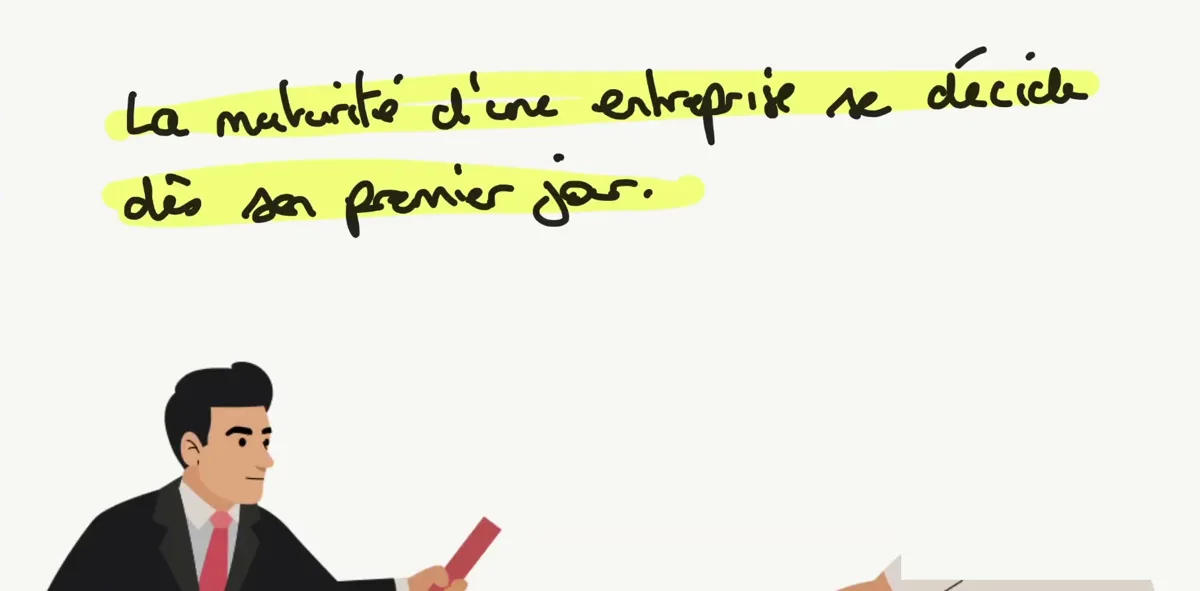
You decide on it from day one.
The technician asks: "What do I need to do today?"
The mature entrepreneur asks: "How does my business need to work to produce these results, without me?"
Two questions, two destinations.
Thomas Watson, the founder of IBM, had a precise picture of what IBM should be from the very start.
His line sums up the book: "We weren't doing business at IBM.
We were building one."
And the best building model of all is a hamburger seller.
Chapter 6. The franchise prototype: what Ray Kroc saw at McDonald's
▶ 09:00 in the videoRay Kroc could have opened a really good restaurant.
He understood something else: McDonald's product isn't the hamburger.
The product is McDonald's itself.

He didn't see burgers, he saw a system.
A system so precise it reproduces itself identically, anywhere, with low-skilled teams.
"Turn the key": you turn the key, the system does the rest.
Gerber calls it the franchise prototype.
1 copy: your shop, with you inside it
According to Gerber, 75% of franchises make it past five years, while 80% of independent businesses don't.
Their product isn't better.
Their system is.
In 2026, the "low-skilled teams" following the manual are also AI.
That's one of the reasons why selling online courses doesn't work anymore.
Chapter 7. Identical 5,000 times: the 6 rules of the prototype
▶ 10:30 in the videoBuild your business as if you were going to copy it 5,000 times.
Not roughly the same.
Exactly the same.

A music box that plays the same tune, every time.
- Consistent value.
Customers, employees and partners get the same experience every time. - Usable by the least skilled person possible.
The expert builds the system, the system does the rest. - Impeccable order.
An orderly setting creates orderly behavior. - Everything is documented.
A manual for every task, or your prototype lives in your head. - A predictable experience.
The customer gets exactly the same thing, every time. - Visible standards.
Colors, uniforms, scripts: everything the customer touches is defined.
Rule 4 is the one everyone skips.
And it's the one keeping you prisoner.
"Anything you don't document, you'll be doomed to do again and again and again."
Gerber's question: how do I serve my customer systematically rather than personally?
The answer is your business.
Not your skills.
Chapter 8. Innovate, quantify, orchestrate: the cycle that never stops
A mature business is never frozen.
It runs on three actions, in this order.
Simplify.
What's stopping your customer from getting what they want from you?
If it makes things more complicated, it's not innovation.
Measure.
How many come in, how many buy, at what time, on which day.
Before and after every change.
Lock it in.
What works gets documented and becomes the rule.
Then you start again.
Gerber puts it his way: creativity thinks up new things.
Innovation does new things.
And if you haven't orchestrated your business, you own itit owns you.
Chapter 9. The problem was never your business
Not the market, not the competition, not the timing.
The problem was your role: technician who doesarchitect who builds.

You work on your business, not in it.
Gerber asks you seven questions, in order:
- Your ideal life.
Not a revenue figure: your real life. - Your standards.
What your business needs to bring in to support it. - Your organization.
How it runs without you. - Your management.
The system produces the results, people manage the system. - Your team.
Hired, trained and guided by the system, not by you. - Your marketing.
Built to attract and keep the right customers. - Your core system.
The tool that runs all of it, like a single customer database.
These questions come back at every stage of growth.
Their answers shouldn't live in your head.
They live in your manual, your processes and your automations.
That's exactly what I do with the GoHighLevel Setup: get your business out of your head.
The E-Myth Revisited FAQ
What is The E-Myth Revisited about?
In it, Michael Gerber explains why most small businesses fail: their founder is a technician who believes mastering the trade is enough to run a business.
The book describes the three stages of a business (infancy, adolescence, maturity) and suggests building it like a franchise prototype.
What is the entrepreneurial myth?
It's the common belief that businesses are started by entrepreneurs.
For Gerber, they're mostly started by technicians who made a fatal assumption: "if I know how to do this work, I know how to run a business that does this work".
The result: a job, not a business.
What does it mean to work on your business, not in it?
Working in your business means doing the tasks yourself, every day.
Working on your business means building the system that does them: documented processes, automations, a team trained by the system.
Replace "business" with "system" and the difference becomes clear.
What is a franchise prototype?
It's a business built as if it were going to be copied 5,000 times, identically.
Everything is documented, usable by the least skilled person possible, and the customer gets the same experience every time.
You don't need to sell franchises: it's a way of building.
Where do I start so my business runs without me?
With documentation.
List the tasks only you know how to do, write down how to do them, then automate or delegate the ones that repeat.
Document, automate, delegate: that's the escape plan from the video, in that order.
If you remember only one thing
Your business isn't your life.
It's there to serve your life.
So work on your business.
Not in it.