











Three years ago, a launch made you six figures.
Today, the same launch struggles to pay back its ads.
Your ads cost 2 to 3 times more for the same lead.
And those leads are colder: they've heard it all before.
If selling online courses doesn't work like it used to, you're not alone.
And it's not you, or your offer, or your niche.
It's the business model itself that's dying.
Here's why, and what's taking its place.

I played the course game, before I saw the wind change.
Why selling online courses doesn't pay anymore
The "record once, sell forever" model is collapsing for three reasons.
Information has become free.
The market is wary after years of broken promises.
And creators give away for free what used to sell for a lot.
Value has moved to coaching and "done for you".
For years, it was a gold rush.
A program recorded once, sold forever.
A tiny team, no delivery, margins brushing 80%.
1. Information has become free
ChatGPT or Claude spit out a custom action plan in ten seconds.
Try it.
Why would your prospect pay €200 to €2,000 for content they get for free in one prompt?
2. The market got poisoned
Years of "gurus" and broken promises have left a mark.
In France, "course seller" is almost an insult.
People are wary, and that's normal.
3. Creators moved upmarket
They give away in a twenty-minute video what you used to sell for several hundred euros.
Quality information has become a simple commodity.
Even the giants, Udemy or CrossKnowledge, are taking the hit.
The real question is no longer "how do I sell my course better".
It's: where can we still bring value?
Because that's what we get paid for.
Value has moved: from information to results
I'm not biting the hand that fed me: this model built me.
But what made it work yesterday is exactly what's killing it today.
Your client doesn't want to be told what to do anymore.
They want you to help them do it.
Or better: for you to do it for them, turnkey.
Today, service is what delivers the highest perceived value.
The catch, historically: it doesn't scale well.
You trade your time for money.
We'll come back to it, because that's exactly where everything changes.
The survivors: three players who changed course in time
Same market, same AI, same collapse.
Some felt the wind change.
Three examples beat any speech.
 Alex Hormozi
His real job: taking stakes in companies that already run.
He made his courses almost free, to bring as many people as possible up his ladder, and get paid at the very top.
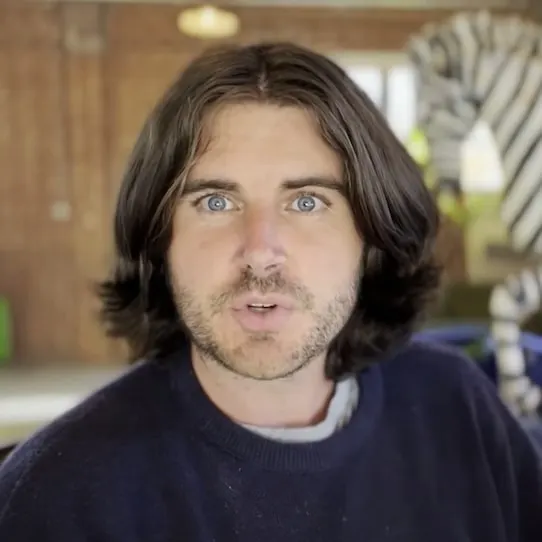 Sam Ovens
Hundreds of millions from courses, between 2014 and 2018.
In 2019, at the height of his success, he dropped everything to launch Skool: community at the center.
Twenty years of losses, then AI explodes.
The stock goes ×3, and Google signs $60M a year to access its conversations.
Reddit didn't change a thing: it was sitting on real human conversation.
What do they have in common?
What matters now is the human.
Not the information.
The value ladder has flipped: DIY, DWY, DFY
Picture three rungs.
"I show you, you do it": DIY, the classic course.
"I do it with you": DWY, community, coaching.
"I do it for you": DFY, maximum value.
Yesterday, the course was at the top.
Look at what's happening today.
- DFYI do it for youcustom quote, rarethe new top: where the margin is
- DWYI do it with youcoaching, communitythe middle rung
- DIYI show you, you do ityour €2,000 course, at the very topthe entry level, almost free: your magnet
Your course is no longer the top of your ladder.
It's become the base.
It's no longer there to cash in: it's there to bring people in.
The ladder didn't break: it flipped.
That's exactly the bet Hormozi and Ovens made.
And Hormozi ended up investing in Skool, Ovens' community.
When the two best bet on the same square, it's no longer a weak signal.
It's where the market is heading.
(To sell with this course at the bottom of the ladder: the sales funnel for digital products.)
The problem with "done for you": it didn't scale
What made courses so beautiful wasn't just the margin.
It's that they grew on their own.
No team, no delegating, no managing.
Service is the opposite.
To grow, you have to hire, brief, supervise.
And it all comes down to two profiles.
- The A-player is you.
Creative, proactive, but terrible at keeping a system running over time. - The B-player is the backbone.
They follow the procedure to the letter.
They're the one who keeps the machine running.
The solo business owner's curse: the only A-player in your company is you.
And you have neither the B-players nor the budget to hire them.
It's the wall Michael Gerber describes in E-Myth Revisited: working on your business, not in your business.
How AI breaks down the wall
An AI is the perfect B-player.
It follows the procedure to the letter, without getting tired, without forgetting, 24/7.
And its job description is your prompt.
at the speed of an info product
Careful, this is where a lot of people crash.
Using AI by hand (a prompt, a GPT) isn't enough.
It's a toola toy.
The real move: build your own tools and plug AI directly into your processes.
That's the whole difference between those who "test AI" and those who actually automate their business.
Becoming a solo AI-preneur: the two paths
A solo AI-preneur delivers the result, done for the client, at the speed of an info product.
The value of "done for you", without its ceiling.
AI opens two paths.
Industrialize your own work
What you do by hand, you turn into a machine.
ExampleA tradesperson I work with was drowning in emails and quotes.
Today, his clients, the history of every job and every deal move along like on a conveyor belt.
He runs his company from his phone, on the job site.
Deliver the result with a custom-built tool
You no longer sell "I'll show you".
You sell "I'll do it for you", and an AI tool delivers.
ExampleA practitioner who preps students for competitive exams used to grade papers by hand.
Her tool analyzes and annotates every paper.
She spends 30 min 5 min checking, instead of doing it all.
On my end, I took the logic all the way.
Funnels, meetings, emails, videos, profitability: every process in my agency became a tool.
One process, one machine.

Middle management is gone.
FAQ
Why doesn't selling online courses work anymore?
Information has become free, the market is saturated and wary, and creators give away what used to sell for a lot.
Ads cost 2 to 3 times more for colder leads.
Courses aren't disappearing: they're becoming a lead magnet instead of a high-margin product.
Value has moved to coaching and "done for you".
What is a solo AI-preneur?
A freelancer who delivers the result, done for the client, at the speed of an info product, because they've handed their procedures to AI.
Instead of hiring a team, they build tools where AI does the work.
Do you need to know how to code to industrialize your business with AI?
No.
You need the right architecture: clear processes, written once, then handed to AI.
The tech can be delegated, or handed to platforms already connected to AI, like an all-in-one tool.
The lever is plugging AI into your processes, not using it by hand.
Where do you actually start?
List your recurring processes: finding clients, content, prospecting, sales, delivery, customer service, invoicing.
Spot the step that takes up the most of your time, and turn it into an AI-driven tool.
One step at a time.
Stop propping up a dying model
Before, to be free, you needed a team running a system.
Today, you need a system run by AI.
And you can build it on your own.
No need to code it yourself.
You need the right architecture: the right tools connected, the right processes.
It's the heart of the A.R.T. method, and of what I build as Custom-Built.
Which process would you turn into a tool
starting tomorrow?